




What do you do with millions of square feet of concrete and glass when the world it was built for no longer exists?
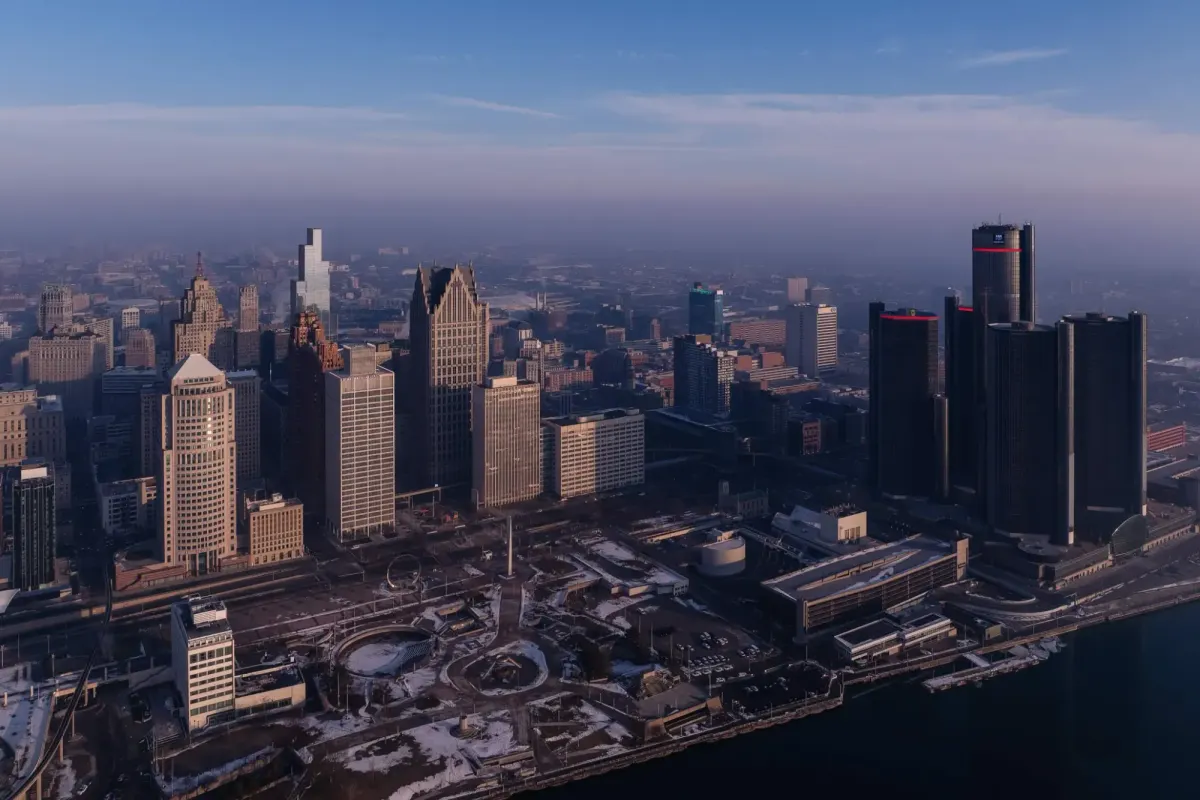
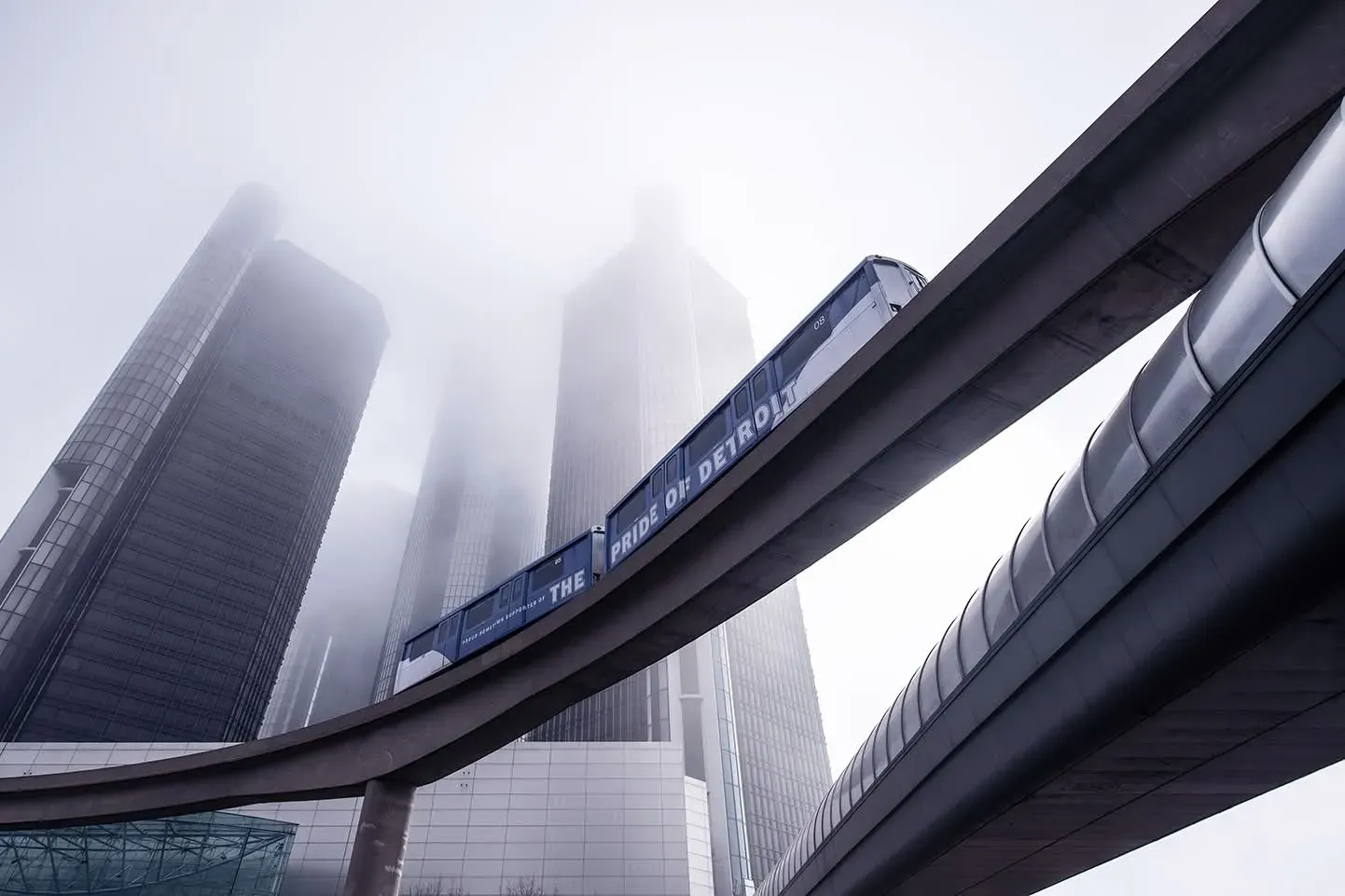
Built in the 1970s as a corporate fortress to keep the city out, the Renaissance Center in Detroit stands today as a monument to a mid-century urban planning thesis that has completely collapsed.
RenCen office occupancy sits under 10%, construction costs are up 55% over the last decade, and downtown real estate demands an entirely new model.
My guests are Jennifer Stallings Dewey, the Senior Counsel, Community Engagement at General Motors; and Jake Chidester, Vice President of Strategic Initiatives at Bedrock.
In this episode, we dive into the multi-billion-dollar proposal by General Motors and Bedrock to demolish two 39-story towers, tear down the concrete podium, and turn an isolated corporate island into a connected, walkable riverfront district.
We answer a ton of listener questions, as well.
The process is ongoing for community feedback.
Here's a calendar of events at their East Riverfront Community Hub: https://detroit-riverfront.bedrockdetroit.com/events
And here is a link to the project survey: https://detroit-riverfront.bedrockdetroit.com/survey
If you don't already, be sure to follow Daily Detroit in Apple Podcasts, Spotify, Pocket Casts, or wherever you listen to shows.
What do you think? Let me know, dailydetroit@gmail.com or 313-789-3211.
Thanks for your support on Patreon! That's how we're able to fund this independent work.
Full Conversation Transcription
This was lightly edited for posting. Please refer to the original audio before quoting.
Jer Staes: Joining me at the studio at TechTown for a very special conversation is a pair of guests. To my left, Jennifer Stallings Dewey, Senior Counsel, Community Engagement at General Motors. Welcome to Daily Detroit.
Jennifer Stallings Dewey: Hi, good afternoon.
Jer Staes: Absolutely. And Jake Chidester, Vice President of Strategic Initiatives over at Bedrock. Welcome.
Jake Chidester: Thank you for having me.
Jer Staes: And I'm guessing, probably because if you've tapped on this podcast episode, I'm guessing you know what we're about to talk about, which is the massive Renaissance Center project, which I think will be possibly one of the most transformative in the city's history. I've taken a number of questions from our listeners over the last month or so, and I have some of my own. But before we get into all of that, I want to talk to both of you, kind of meet you a little bit, and talk about your backgrounds. Not only your backgrounds, but how did you come to work with the project? Jennifer, why don't we start with you?
Jennifer: I'm an attorney, a transactional attorney who's done a lot of work in policy, economic development, and things like that. I started working at GM about six years ago doing just that—working with our dealers, in issues within the dealer network, and have more and more gotten involved with policy, economic development, and now community engagement efforts for GM.
Jer: I can imagine that dealing with dealers is a very wide level of stakeholders there. They all kind of have their own, just from my own experience covering automotive, they all have their own projects and things that they're working on.
Jennifer: Exactly, you're always balancing a lot of different interests, and there's a lot of commonality in the work that happens between GM and its different partners.
Jer: And Jake, how about you?
Jake: My background is in architecture, design, and urban planning, actually. I've had the opportunity to work for a few different firms here in Detroit, really since 2006, which is when I moved to the city. I joined Bedrock in 2015, initially to help guide our in-house design, architecture, and planning teams. I had the opportunity to work on our fantastic adaptive reuse portfolio at that time: the Book Building, the David Stott, the Free Press Building, as well as City Modern in Brush Park. I started working on the Renaissance Center and East Riverfront project with General Motors about two and a half years ago, when we saw a real opportunity to redevelop and reposition this.
Jer: For you in that work, since you've dealt with so many of these buildings that a lot of our listeners are very familiar with or in love with—whether it's the Book Tower, back in the early 2000s, all that kind of stuff—what is something that you feel like you've learned doing this work along the way over the last number of years?
Jake: I would say that place matters. Taking an historic project and repositioning it, but keeping the essential character, nature, and place of it, has real value—not only from a user experience and a Detroit history experience, but from a development standpoint as well. People sense authenticity, and they're drawn to these historic and adaptive reuse projects because of that hyper-local Detroit authenticity.
The History & Current State of the RenCen
Jer: Let's talk about the state of the project as it is today. General Motors, was it 1996 that you all have owned it since then? There's been a lot of story between then and now. A lot of people might not go to the RenCen every day. They might not see everything that's been there over time, or maybe they have some really great memories from high school or prom.
For me, I have always been around the RenCen; it's a place I remember all the way back to the movie theaters, my tailor was in there, that kind of stuff. But I also know that there's been a lot of change with the complex and the company over these last few years. So why don't we talk about how we got here? Because when I've talked to listeners, they'll ask, "How was it not full?" They drive by it, but they don't go to work at it. They see this building, they see the sign on top, and it kind of befuddles listeners. Where are we at, how did we get here, and what is the state of the building right now?
Jennifer: Not to go too far back in history, but the building was built in 1976 by Ford and a coalition of other business and community leaders. It was purchased by GM in 1996. In the 30 years that GM has owned the building, we've spent over a billion dollars in trying to make investments in the building to make it more accessible and usable for the city of Detroit. We took out that concrete berm that existed on Jefferson, we put in the Wintergarden, GM Plaza, and GM Fountain, which is sort of the beginning of this larger project. But over time, it's just become more and more clear that it's not a viable space in its current state. The way that everyone uses office space and commercial space has changed so much over the past few decades, and that's made the situation where occupancy is under 10%. It's just not viable in its current state, so we really had to say as owners, "What do we do so that we can still save the good parts of this building?"
Jer: So to be clear, there are a lot less GM employees working there for various reasons than there used to be, correct?
Jennifer: Like any company, our use of office space has changed over the last few years, but we've concentrated our footprint. We still have employees, and some really big, important functions for the company still exist in the city of Detroit. We've moved our headquarters to the new Hudson's building to a space that just has more flexibility and makes more sense for what we need as a company.
Jer: Over the years, I've seen the shift and how it had begun even before the pandemic in some ways.
Jennifer: Like you, I've spent a lot of time in the RenCen. I'm a native Detroiter, and as a kid, I would come down—my dad had a store in the Millender Center. I lived in those apartments when I started working downtown. We would go to the building, and it has just changed so much over the years.
Jake: From an historic perspective, the Renaissance Center was really facing financial trouble almost immediately after it opened. In 1982, which was six years after it opened, it was already facing insolvency. I think that's a little-known story there. The reason why is because from day one, it was overbuilt, it was on an island, and it was impossible to navigate. General Motors did a fantastic job trying to mitigate some of those baked-in design deficiencies, but ultimately, the original flaws of the Renaissance Center really could not be outrun. It just caught up to General Motors and it caught up to our market. What we have today is a building that, because it's an island, because it's inward-facing, because it is south of Jefferson, has really not experienced any of the benefit of the economic growth that the rest of downtown has seen. It was built as a city within a city in a very different time in Detroit's arc, and now because it's closed off, it has not been able to benefit from what Bedrock and our public partners have done around it on Woodward.
Vision for the Redevelopment
Jer: What's the plan on the table now? What does the vision now look like moving forward as you all see it?
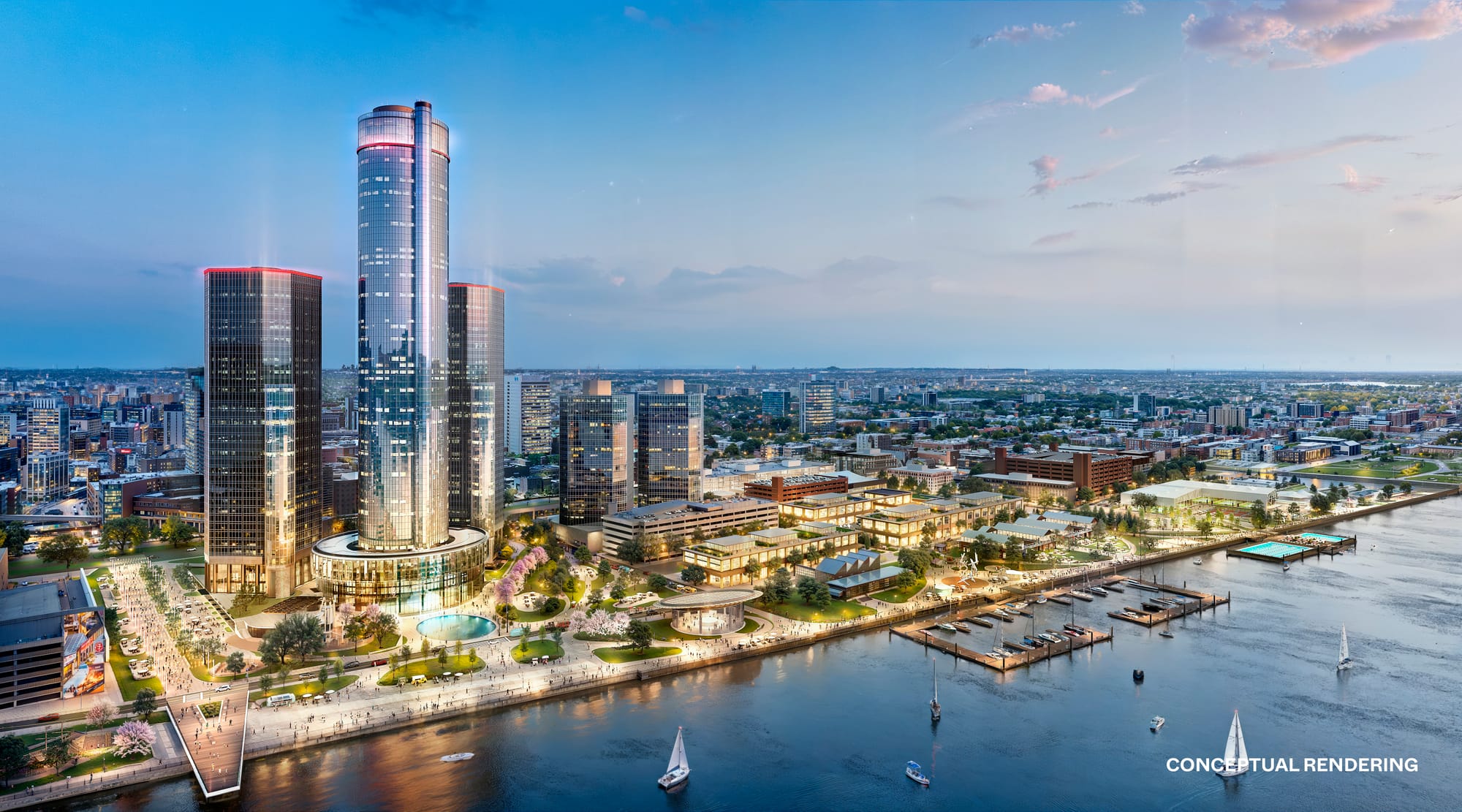
Jake: This project really combines two big projects: the redevelopment and repositioning of the Renaissance Center, and the development of the East Riverfront. The Renaissance Center itself is a 5.3 million-square-foot building. The plan there is to keep what's working, take out what's not working, and add in what's missing.
Keeping what's working would be the hotel and hospitality. The hotel has been very successful there since it opened, and the plan is to keep the hotel as a centerpiece.
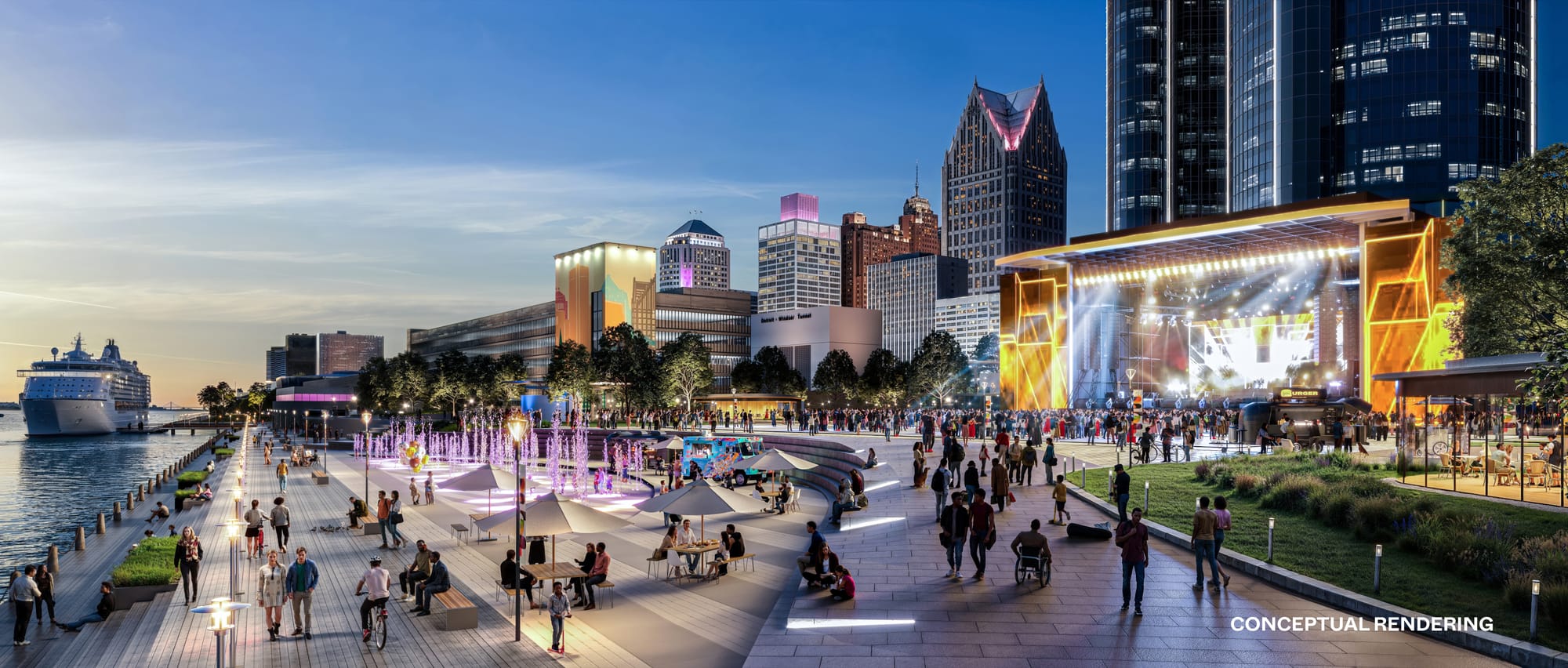
Removing what hasn't been working starts with the podium, which is that 1.5 million-square-foot labyrinthine base that is an entire city superblock, is difficult to navigate, and really is a physical and visual barrier between downtown and the riverfront. Getting rid of that podium allows us to open up the entire 12 acres that the complex sits on to be able to connect directly from downtown, through Jefferson, to the waterfront.
Then, the removal of two towers: Towers 300 and 400. Today, that's office. Across all four towers today, there's actually about 2.7 million square feet of office space, and there really is no trajectory in which we're going to be able to fill that with office—not just us as Bedrock, but us as the downtown market.
There's about 17 million square feet of vacant office space across the tri-county area, and last year Detroit leased up, net new, 30,000 square feet.
Jer: Wow, that's a stunning number.
Jake: By that logic, it would take almost 80 years to lease up the 2.7 million square feet of office at the Renaissance Center, assuming nothing else gets leased up across the entire 139 square miles of Detroit. By taking down those two towers, our position is that we can then create more open, highly programmable civic space adjacent to the waterfront.
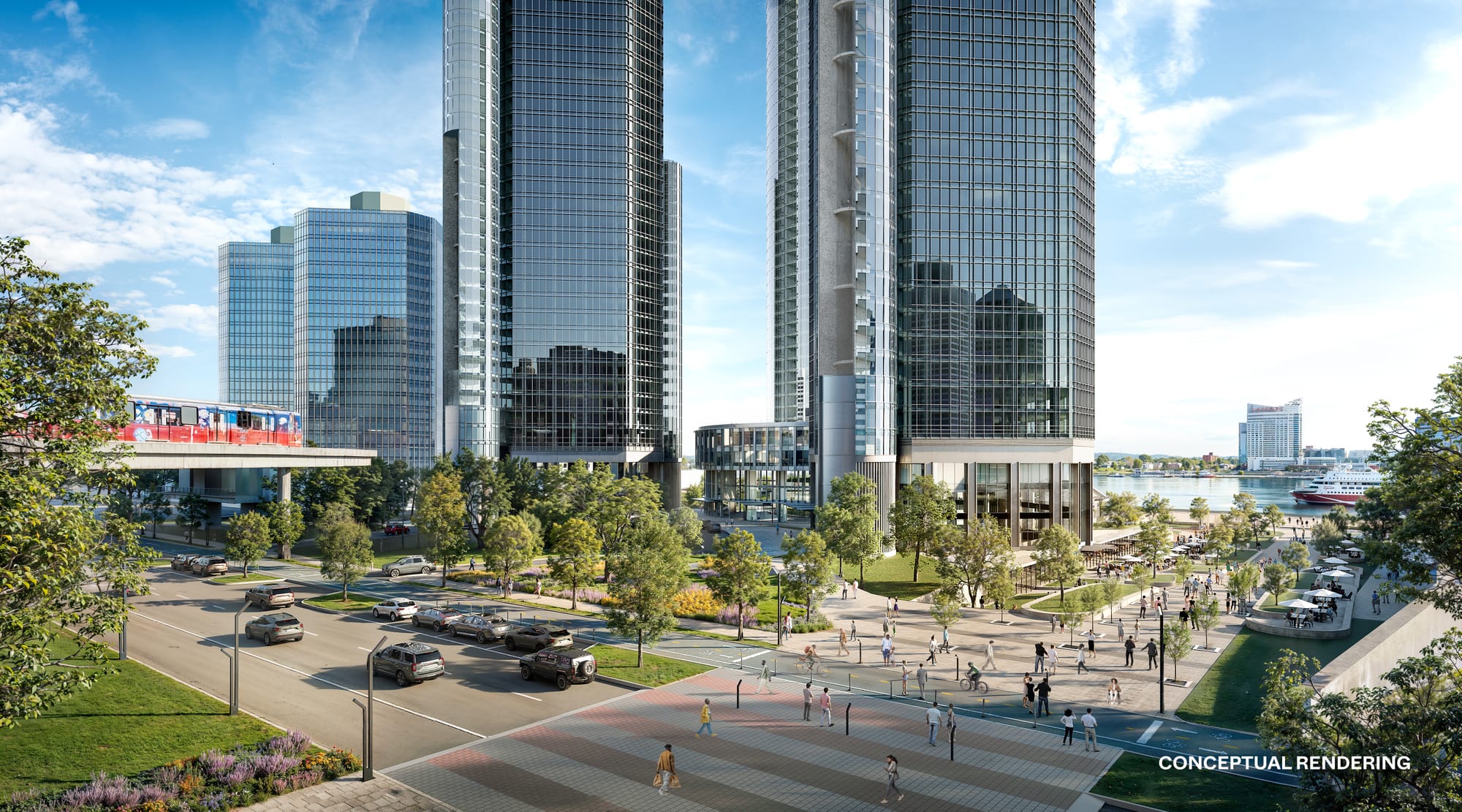
The three towers that remain—the central tower plus Tower 100 and Tower 200: Tower 100 is converted into mixed-income multifamily (about 400 units), and Tower 200 stays as office. That's about 600,000 square feet of office, which is a lot, but we feel confident that over a 10-year time horizon we have a better chance of filling that than 2.7 million square feet. So: hotel, multifamily, office, civic space, and the whole thing is opened up to better connect the waterfront to downtown.
If you go east, there's about 30 acres of surface lots. You have the Riverwalk, which is continuous from one side of the site to the other, but once you go just past that Riverwalk easement, there are these surface lots that used to be used for General Motors parking a decade ago.
The plan is to transform that 30-plus acres of empty surface parking into a regional, family-friendly entertainment destination. What the Riverwalk is really demanding is commerce and active spaces. You step just outside that easement, and there is no density of family-friendly things to do outside of park space.
Jer: When I've visited other cities like Chicago, I love our Riverwalk, but when I think about activations, I realized we could have more opportunities for entrepreneurship, restaurants, rental things, or place-making. Our riverfront is wonderful, but what's that plus-one to get you to spend more time there?
Jake: Anything that we do here has to be an extension of the Riverwalk. From a user experience, at no point should it feel like you're stepping outside of the Riverwalk onto a Bedrock or GM development. It's all part of the entire district experience that needs to be curated, which will include food, beverage, entertainment, additional multifamily, as well as highly programmed, highly curated year-round civic space.
Jennifer: A place that's really uniquely Detroit, still.
Unpacking the Project Finances
Jer: Let's talk about the finances of this, because that's really what's caught a lot of people's eye. We're talking about an incentive package that has a lot of pieces in it, and it's important to unpack what it looks like and what it actually means. The public sees a summary headline and thinks, "Am I writing a check?" So I want to unpack what both of your organizations are putting in, what you're looking for, and what that would do.
Jake: General Motors is participating to the extent of $250 million.
Jennifer: Yes, as the current owner, we're investing so we will be involved going forward as well.
Jake: 75% of this project, which includes the Renaissance Center and River East, will be financed through Bedrock and General Motors. We have an incentive package on the table that accounts for the remainder of that, using three tools to get this job done.
Development in Detroit has a math problem where construction costs have been increasing by 55% over the past 10 years, but Detroit has the highest property tax of any major city in the U.S., and rents have not risen commensurately with construction costs. It costs as much to build here, pound for pound, as it does in Chicago, Atlanta, or Denver, but there's no channel to get the return on that because of stagnant rental rates on commercial real estate.
Even with incentives, the project is effectively a not-for-profit endeavor. This was presented by the DEGC during one of the community benefits meetings—that even with the incentive package, the cash-on-cash return for this development is 1%. That is less than inflation. When you adjust for IRR (Internal Rate of Return), the project effectively just makes enough money to keep the lights on.
Jer: As someone who runs a business, 1% almost gives me a different kind of fear, because if you're only making 1%, why do a 1% project?
Jake: For us, this is a public commitment and a civic investment. This is the next decade of the work that Bedrock and Dan Gilbert intend to take on in downtown Detroit. Over the last 15 years, Bedrock's focus has really been on the Woodward corridor—densifying it, rehabbing historic architecture, delivering Hudson's, and making sure every block is active and clean.
The next logical opportunity for us and our civic partners is the east-west corridor that is the riverfront. You have to start with the Renaissance Center. If we were to just look at the East Riverfront, it would still be separated from downtown by this massive icon that today is effectively vacant. Even though the returns don't make sense, the Renaissance Center is a critical gateway piece to connect downtown with the waterfront, and that's why we're committed to investing in this project at effectively a zero return.
Jennifer: GM just sees it as the right thing to do. This city has been our home to our headquarters for over 100 years. In the past decade, I believe we've invested over $150 million in charitable contributions. This is a place that we believe in, and this is the next stage of that. We're thinking of it more along the lines of a charitable endeavor than money-making, but it's the right thing to do. Reimagining it is a way to preserve the things that are so great about it and to give Detroit the riverfront that it deserves.
Jake: There are projected downstream economic benefits to the city, even if the developer at face value is not making a return. We believe the city will get a return on this project because it has the opportunity to be another front door to our city, a destination for Detroiters and visitors, and an opportunity to take advantage of our position on an international waterfront.
Exploring Alternative Options: Why Not Mothball? & Structural Challenges
Jer: One of the things listeners keep asking is: why not mothball it? Why not just wash the windows, lock the doors, and do something like that?
Jennifer: Uncertainty is really scary, and that feels too risky. We've seen so many properties sitting vacant in Detroit—who knows who would come or when they'd come, and that's just not a responsible move on our part.
Jake: We looked at every possible redevelopment scenario for the Renaissance Center with two general contractors and two architects. We looked to validate every possible approach:
Demolishing the whole thing: Not the right thing to do, so that's off the table.
Keeping all towers as office: Not viable given the vacancy and absorption numbers.
Mothballing: The challenge there is indefinite vacancy. Michigan Central is a fantastic success story where Ford invested a billion dollars, but it was a blighted eyesore for 35 years before that commitment. That can't happen to the RenCen downtown. This icon cannot become an icon of vacancy or lost opportunity.
Converting everything to residential: Multifamily conversions in these towers are very, very difficult.
Jer: Why is that? Why not just load it up with multifamily?
Jake: Old 1920s or 1950s Art Deco buildings convert nicely from office to multifamily because of narrow floor plates, a central elevator core, and lots of windows. The challenge with the RenCen towers is, first of all, they're octagonal. Eight-sided buildings are very difficult to convert to residential where every bedroom needs a window and you have to address the center core space.
From an MEP (Mechanical, Electrical, Plumbing) standpoint, everything in these towers is 50 years old. Every floor plate currently has one men's room and one ladies' room right in the middle. Every apartment wants its own bathroom and kitchen, which involves reworking every single floor plate to distribute that plumbing.
Right now, there's one temperature control system per floor, but every apartment needs to control its own temperature. It's an overhaul of the entire primary and secondary mechanical, electrical, and plumbing systems. Because these are 39-story buildings, you have to drill through every single reinforced concrete and steel floor while keeping the structural integrity intact on a building that was not designed for residential use. The cost amounts to a price tag of about $400 million per tower. For the two towers on the waterfront, that's an $800 million price tag. For $800 million, we can add a lot more value to the surrounding area, to the East Riverfront, and to connecting the Renaissance Center to downtown.
Tax Incentives & Public Financing Tools
Jer: I'm most familiar with the Brownfield part of the financing, but can you walk through the three major tools you mentioned? How does this corporate ask work?
Jake: The Transformational Brownfield Plan allows the development team to capture a portion of the tax value generated from the project. There is no check upfront; it is all performance-based on the back end. If we create value through development, we capture a portion of that taxable value to help offset project costs. If we don't deliver, we get zero. If we deliver half, we get 50%. Today, the vacant asset generates very little tax money. When converted to multifamily, entertainment space, and a revamped hotel, it adds increased value, and we only capture a portion of the value we're creating. We get to eat a part of what we grow.
Crucially, we as developers have the opportunity to capture Detroit taxes, but we are opting out of that. We are making sure 100% of the value generated stays in Detroit.
The second tool is the Ren Zone (Renaissance Zone) and the PA 210 (Commercial Rehabilitation Act). The Ren Zone abates some taxes for a period of time and allows us to make a PILOT (Payment in Lieu of Taxes). This ensures that taxing jurisdictions, schools, and libraries are held harmless and made whole. It also allows us to bypass part of the DDA's (Downtown Development Authority) capture. Without these tools, 75 cents of every dollar of value created would be captured by the DDA rather than going to local taxing jurisdictions, schools, libraries, and community colleges.

Keeping The Riverwalk Open & RenCen Deconstruction Methods
Jer: Let's get into listener questions. First: Riverfront access. People are worried that during construction, they're going to lose access to the riverfront.
Jennifer: Our goal is to maintain access to the riverfront and keep as much of it open as we can during the entire process.
Jake: At no point are we going to put up signs saying, "Closed for 10 years, see you in 2037." What we're doing will honor and expand upon the work the Riverfront Conservancy has done. This part of the Riverwalk is actually at capacity—it was delivered around 2000, and with e-bikes and scooters now, there's an opportunity to expand the Riverwalk here to accommodate greater usage.
Safety and environmental impact are the top priorities. During deconstruction, the towers will not be imploded.
Jer: My media career started covering the implosion of the J.L. Hudson building, and that dust went everywhere!
Jake: This won't be that. The towers are proposed to be deconstructed by wrapping them in a metal mesh fabric and working from the top down. We gut the core where the elevators are, start at level 39, and use small pneumatic tools to break down material, dumping it down the center core to the grade level where it's sorted and taken offsite. As it moves down floor by floor, the scaffolding moves down, so you'll see the towers gradually shrink rather than being knocked over all at once. That allows us to keep the Riverwalk open with proper overhead scaffolding and protective barriers. The podium base will be taken down using traditional demolition methodologies.
Timeline, Infrastructure, & Future Uses
Jer: What is the overall timeline, and what will people be able to use sooner than later?
Jennifer: Selective deconstruction is scheduled to start in summer 2027. That's when people will see things happening on site.
Jake: We need to keep the complex open for two major events: the NCAA Final Four and the 2027 Grand Prix, to keep those hotel rooms online. After the Grand Prix in 2027, the project starts in earnest. It will be a phased 10-year project, delivering the revamped hotel, mixed-income housing, waterfront access, food, beverage, and entertainment amenities.
Jer: What about connecting to the rest of downtown across Jefferson?
Jennifer: The RenCen was intentionally designed to be set apart. A big impetus for this project is opening it up and adding a pedestrian walkway to connect downtown to the RenCen and the riverfront.
Jake: This will be done in conjunction with MDOT's work on Jefferson and I-375. Raising I-375 to grade will normalize intersections, allowing pedestrian, car, and bike access directly to the site via a new boulevard. Further studies will look at pedestrian crossing improvements, traffic signalization, and road diets west toward Washington Boulevard.
Jer: What about amenities on the surface lots? Everyone keeps asking for a movie theater.
Jake: If we don't deliver a movie theater, we've failed! People shouldn't have to leave the city for baseline amenities like movie theaters, venues, or water parks. We've received about 3,000 survey responses and had thousands of conversations at our community hub at 521 Atwater to understand what Detroiters want to see built on those surface lots.
Jennifer: We're still collecting that feedback, so there are still opportunities for people to share their input.
Jer: Why no for-sale condos?
Jake: We always start with the rental market, balancing market-rate and affordable housing (with 30% of units targeted at 60% AMI). The condo market typically lags behind a stabilized rental market. We are delivering our first condos at the Hudson's development now, and once the rental market stabilizes here, for-sale housing can be explored.
Jer: Why not just make a zillion hotel rooms?
Jake: To create a true 18-hour neighborhood, you need full-time residents living on the East Riverfront, not just a transient hotel population.
Jennifer: The diversity of uses—residential, hotel, civic, retail—is what sets the project up for long-term success.
Jake: To be successful, this has to be for Detroiters, by Detroiters. It needs an authentic Detroit identity to serve local residents while welcoming out-of-town guests.
Jer: Jennifer Stallings Dewey from General Motors, and Jake Chidester from Bedrock, thank you both for joining us on Daily Detroit.
Jennifer: Thank you so much for having me.
Jake: Anytime.