
Michigan’s House Is On Fire. Can Common Ground Save It?
A conversation with Sandy Baruah of the Detroit Regional Chamber
 Jer Staes
Detroit, MI
Jer Staes
Detroit, MI
Player
Show notes
Today we talk about how Michigan slipped from a top‑tier state into the bottom 10 on key measures like education, income and population — and why acknowledging the crisis is the first step to fixing it.
Today's conversation is with Detroit Regional Chamber president and CEO Sandy Baruah gets into this year's urgent theme at the Mackinac Policy Conference: "The house is on fire."
Sandy explains why he thinks more common ground between business and policymakers, and between Democrats and Republicans, is the only way to reverse those long‑term trends.
We get into how constant partisan whiplash on policy, from electric vehicles to economic development, makes it nearly impossible for Michigan's signature industries to plan long term.
They close on what success at Mackinac would look like over the next one to five years — from educating a whole new wave of elected officials to locking in 70‑percent solutions instead of all‑or‑nothing showdowns.
And, despite the alarms, Sandy lays out why Michigan's quality of life, workforce, and higher‑ed system still give the state a real chance to win.
A full transcript of the conversation is below.
Feedback as always, dailydetroit - at - gmail - dot - com or leave a voicemail, 313-789-3211.
Follow Daily Detroit on Apple Podcasts or Spotify, or wherever you get shows.
Transcript
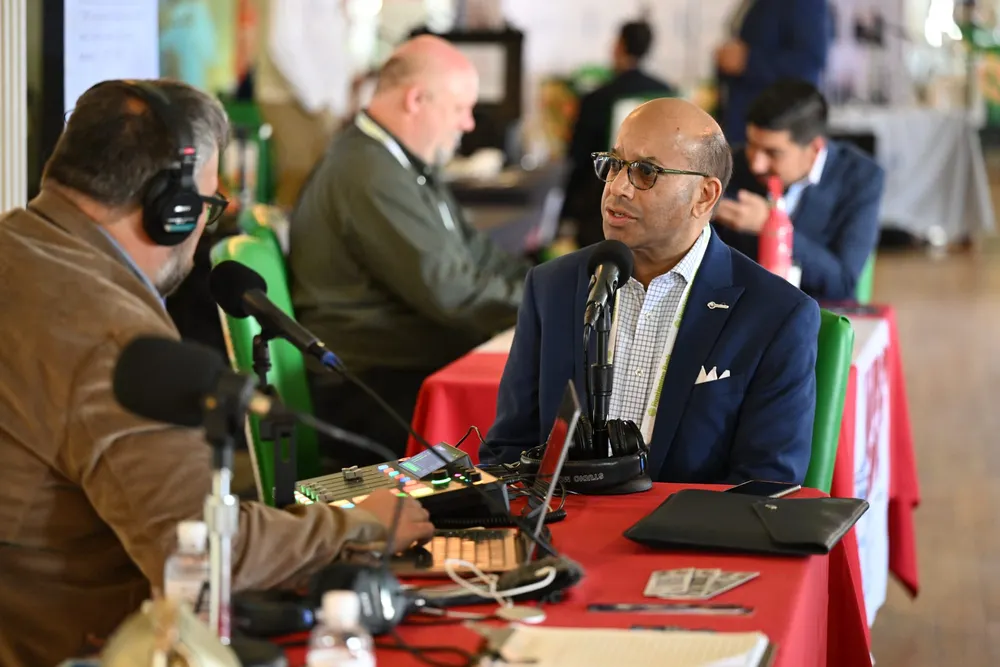
Jer: Joining me here at the table at the Grand Hotel at the Mackinac Policy Conference is somebody I’m very excited to finally have join us on Daily Detroit, Sandy Baruah of the Detroit Regional Chamber. I guess I’m at your party.
Sandy: Welcome. Welcome to our party. Obviously, it’s a policy conference. That’s not to say that we don’t want people to enjoy themselves. We like to say this is where we make policy and politics fun.
Jer: What is your passion behind policy and politics? You’re somebody who always brings a lot of ideas and a lot of energy. What has been your spark for policy and politics?
Sandy: Our job here is really to bring together policymakers and our business community. We are a business organization. We represent businesses not just throughout the Detroit region, but across the state. And the question is: how do we come together as a business community and those whom our taxpayers fund to write our laws and implement our laws? How do we get them talking to each other in a meaningful way?
That certainly happens up here on the island. It doesn’t always happen in Lansing. Some of those Lansing meet‑and‑greets are pretty short and hopefully sweet. So we try to have much more substantive conversations up here.
Jer: And it’s good to have that space. One of the things I learned when I worked in corporate communications is sometimes you do have to step away, because the day‑to‑day of business, lawmaking, all that other stuff, doesn’t give you the clarity of space to really dig into some of these issues. Over the years you’ve hit a number of very serious ones.
This year, the theme is “the house is on fire.” That’s something you’ve talked about along with “common ground.” Why those two things this year, and what was the impetus for you?
Sandy: They’re certainly related. “House is on fire” is about using our platform as an organization that frankly can command a microphone statewide. The media respects us, pays attention to us, and being the largest business organization in the state, when we say something people will at least not ignore us.
We wanted to use that platform to really stress to the media, to business leaders, and hopefully to the population at large that, hey, Michigan, we know you think we’re about an average state when it comes to critical things like educational performance, population stability, per capita income, or GDP. People think we’re kind of dead average, but in reality, we’re dead last. We have fallen from being a top‑15, top‑20 state 25 years ago to being in the bottom 10.
Jer: For you, what’s your hope in having this conversation for lawmakers and for your fellow business community?
Sandy: It’s really hard to fix a problem if you don’t know the problem is there. It’s a little bit like having a leaky roof but not knowing you have a leaky roof. You’re not going to fix it unless you know it exists, right?
So we’re trying to highlight and point out that Michigan has a lot of holes in our roof that need to be fixed. We’re pairing that with “common ground” because the only way to fix these problems, to reverse these trends where we’ve gone from top 15 to bottom 10, is common ground. We need the business community and the political community to come together. We need Democrats and Republicans to find at least some common ground.
We’re not asking the parties to agree on everything. That would be silly and completely unachievable. But can we get a framework between the parties so we can get 50, 60, 70 percent of some of these problems tackled, share the credit, and accept that we may not get everything fixed — but at least start somewhere?
Jer: I think back to an interview I did — one of the final interviews with former Senator Carl Levin before he passed away. One of the things he said was that one of the best ways to get something passed is to take no credit or give credit to someone else.
Sandy: That’s exactly right. Ronald Reagan used that phrase as well. In fact, that’s a great example of common ground: Carl Levin, a Democrat, and Ronald Reagan, a Republican, operated by the same motto.
Jer: Does the state of discourse around things, just in general, frustrate you?
Sandy: Oh, certainly. I’m a longtime Washington guy. I started in Washington on the Senate side of the Hill in 1985 and left my last job as a federal agency head in 2009.
The drastic change in the tenor, the relationships, the language in Washington over that period was dramatic. By the time I left, I was ready to leave.
Jer: Except for the strong partisans, it really feels to me like a lot of the public is frustrated as well because often the issues that matter to us every day end up getting ignored.
There may be a top issue that’s really emotional or whatever, but there’s so much important work on the city, state, local level — day‑to‑day policy stuff that impacts lives.
I get frustrated because I want to talk about those things too. It’s great to get the clicks and the headlines, but that doesn’t always actually change lives on a daily basis, you know?
Sandy: I think that’s why Mike Duggan was so successful as the mayor of Detroit. He didn’t care who got the credit. He never fought with the city council. If the city council thwarted something he was doing, he would say, “Okay, I’ll go back, I’ll regroup, and I’ll try it another way.” He was really focused on problem‑solving.
The recovery of Detroit has been so successful, but you cannot point to any idea implemented by the city council or by the mayor that was a “Democratic idea” or a “Republican idea.” It was just good policy. It wasn’t, “We’re going to implement a Democratic agenda in the city of Detroit” or “a Republican agenda in the city of Detroit.” We didn’t have to do any of that.
Jer: And that’s the thing. When you look at successful cities and successful communities, you can find them on both sides of the aisle. It’s about that focus and consistency and saying, “Hey, what is actually going to work for people?” That’s the frame I’d really like to see more of.
Sandy: We’re talking about that as well in terms of finding common ground. One of the challenges Michigan has is that the “Michigan U” is not just a traffic pattern in our state, it’s actually our policy approach. We don’t stick with strategic solutions at the policy level long enough to see if they’re going to work.
You can name any critical element: economic development or community growth, education reform — these are all strategies where we’ve had not just start‑stops, but complete shifts. We go down Avenue A and then a few years later we decide, “We don’t like Avenue A, we’re going down Avenue Z.” We stick with neither strategy long enough to see if it will actually work.
Jer: So why do we keep doing that, do you think? Is there a cultural issue? Is it an incentives issue? Because I agree with you that it’s important to change that.
Sandy: Part of it is that being a purple state — and we are the largest purple state in the country — is both a blessing and a curse. It’s a blessing in the sense that no one political party dominates our politics. Democrats and Republicans both have a decent shot at controlling, for lack of a better phrase, the state of Michigan — winning statewide seats, governor, legislative control, etc.
The problem with being a purple state is that since both sides have a fairly equal chance of controlling the state, they do — and we go back and forth between Democratic control and Republican control, and everyone wants to implement their way. It used to be in this country, at the federal level and in the states, that a new governor or new president would come in and respect a large portion of what was done before, because there was a realization that whipsawing back and forth on policies is hugely damaging.
I’ll give you an example we’re knee‑deep in: neither the Biden administration approach nor the Trump administration approach to electric vehicles, or to the auto industry as a whole, is the right approach. Neither one of these administrations is tackling it correctly. But what’s worse than not having the right policy — or even a set of almost‑right policies — is the whipsawing back and forth.
Automobiles and mobility are very capital‑intensive businesses with very long lead times for planning. If we’re going to change policy in such a dramatic way every four years — we went from the Obama policy set to the Trump policy set, back to the Biden/Obama policy set, and now we’re back to the Trump policy set — how do you plan global billion‑dollar businesses that need a decade of lead time to make smart investments when your policy landscape changes dramatically every four years?
Jer: And then lay on top of that global competition, because the EV race has really heated up. That kind of whipsawing, in my opinion, puts our hometown team at a disadvantage.
Sandy: Absolutely. That’s my point — you just made it much more succinctly.
Jer: I have a microphone. I use it from time to time.
For you, representing the business side of things, what are some things you think the business community could do and rally around to help push things forward — and also help put some water on the fire?
Sandy: Certainly the business community can and should play a role in educating all of the new elected officials we’re going to have come November. We have an open governor’s seat, an open U.S. Senate seat, an open Attorney General, an open Secretary of State. We have at least three open and potentially competitive congressional districts, and our entire legislature — both the Senate and the House — is up for reelection.
So we’re going to have a sea change in our elected officials. The business community really needs to take the lead in educating these legislators. There are a lot of smart legislators and a lot of smart people who run for public office, but they’re not experts on every issue. The automotive industry is super complex. Many of them have never run a business. They might be in some form of public service, which is great and honorable, but they don’t necessarily know anything about business. It’s up to the business community to work overtime this fall and into the new year to help educate these new lawmakers.
Jer: Over and above that, are there ways that the business community can do things people feel on the ground — to get people involved? I think about Detroit where I see all the work Dan Gilbert’s done. It really has touched a lot of people; you can see and feel those new improvements.
Are there ways the business community can take that lead — job training or things like that — to use that power and, of course, benefit businesses as well? It’s not all charity; you’ve got to look at ways to build the company.
Sandy: Certainly, businesses that succeed respect the people who work for them and give them time to volunteer and be engaged in the community. They also find ways to give back in multiple ways.
One small example: Mayor Duggan got many large businesses in the area, like Rocket, Penske Corporation, and some of the automotive companies, to adopt neighborhoods and let the neighborhoods determine what was needed. For example, Penske Corporation adopted a neighborhood fairly close to my house, in the East English Village area near the water by Grosse Pointe. The community there said, “We really need help with seawall issues, and our park/community center has become completely overrun and derelict,” and that was causing a real problem. Penske stepped in and did a lot of work on those areas.
Jer: Yeah. So we have this theme — we’ve had different episodes talking about the data ourselves and things like that. What does success look like for you? I know this isn’t just a one‑year project, but coming back one year, five years from now, what would make you say, “We did this, we brought these people together, and we’re moving forward”? If you don’t measure it, you won’t make it, right?
Sandy: Certainly, can we educate these new lawmakers I just mentioned? Can we educate them about the issues for economic growth, job growth, and income growth in our state? And can we do it in the vein of common ground?
Can we get these new elected officials to commit to saying, “Okay, I will seek areas of common ground with people on the other side of the aisle and try to get at least 70 percent”? If we can find solutions where 70 percent of what I want works and 70 percent of what you want works, and there’s that Venn diagram, then let’s agree to the 70. Let’s enact the 70, move that forward, and then figure out the rest later.
Jer: That’s the thing. It seems like right now there’s so much in the political discourse where it’s all or nothing. But that isn’t how the real world works. That isn’t how friendships work. That isn’t how family works. Nothing works like that, right? So it makes perfect sense to me that some of the political issues we’re having right now come from that disconnect.
Sandy: So much of it frankly has to do with fundraising. If you’re running a campaign or even just a strategy for a political party, what raises money? If I’m party A and you’re party B, I raise more money if I say you, party B, are the worst thing on the planet. “Everything party B wants to do is bad and will make you grow a third head. If party B gets elected, aliens will attack the planet. But if you elect me, party A, everything will come up roses.”
That’s why negative ads are so prevalent. It’s not in the fundraising interest for either party — Democrats or Republicans — to say, “Hey, I’m a Democrat, and I can get behind 50 percent of what my Republican opponent is talking about. Fifty percent I’m against, but 50 percent I can support.”
Okay, that’s a base to build on. Can we negotiate another 30 percent and get it to 80? Then at the end of the day, 20 percent you’re going to disagree on.
I’m old enough to remember when that’s how it used to work in Washington. But if you do it that way now, you lose the issue — the issue that raises money, that lets you light your hair on fire on social media or TikTok or something like that.
Jer: And I could count countless examples on both sides of the aisle. I remember them in my head over and over again where there’s actually a win to be had, and people didn’t take it. I would argue that most voters — part of the reason the electorate is frustrated with both parties, to be honest with you — is because they’re busy worrying about fundraising and not focusing on what we need to get done.
Sandy: That is why both parties — Democrats and Republicans — continue to shrink as a percentage of registered voters. It’s the independent block that is growing by far the most. People ask, “Why don’t we elect more independents?”
There are very serious structural impediments that both parties have put up, both at the state and national level, that make it very difficult to run successfully for office as an independent. Mike Duggan’s campaign just proved that.
Jer: And it’s even hard to put together a third party, let alone if you want to find friends and actually file something.
Sandy: The impediments for a third party are exactly the same as the impediments for an independent campaign.
Jer: Are there things we could do to change that incentive structure? In business, everyone responds to incentives. Could we find a way to tweak the system? If fundraising is part of the issue, are there ways we could adjust that?
Sandy: I hope so. There have been some efforts. Some of the leaders I know personally. From an election standpoint, there’s some efficacy to looking at “jungle” primaries or open primaries, runoffs as opposed to the traditional primary system.
Now that we’ve seen several examples of those kinds of systems across the country, the results are mixed. Campaign finance reform is really tricky because you run into free‑speech issues — legitimate free‑speech issues — so it’s harder to regulate that. It’s hugely complex.
At the end of the day, it’s the two parties — Democrat and Republican — that control our system. For example, in Michigan today, as it has been for quite some time, the party that controls the Secretary of State’s office gets to choose the order in which the gubernatorial candidates appear on the ballot.
Jer: As in how they’re printed?
Sandy: Yes, how they’re printed. Just to be clear, I’m not trying to take a shot at Jocelyn Benson because she’s going to appear first on the ballot anyway, since her last name is “Benson.” So not an issue. But had her name been “Zilwicki,” she could have put that at the top of the ballot, right?
There are huge fundraising constraints. The limit that I, as an individual, can give to an independent campaign is far less than I can give to a Democratic or Republican campaign. If I’m an independent candidate for office, I have to raise significantly more signatures — I’m going to get the number wrong, so please don’t quote me, audience, but I think it’s like two or three times more signatures — which obviously adds to your cost.
And then there are things like party infrastructure. There is no independent party infrastructure. Being an independent means there is no party. So you don’t have a bank of volunteers; you have to build it from scratch each time.
Jer: Why don’t we land on some hopeful things? What are you hopeful about in all of this that keeps you doing the work? You must think there is a way forward.
Sandy: Absolutely. First of all, here we are at the beautiful Grand Hotel on Mackinac Island. This is such a beautiful state. We have such a high quality of life, and an affordable quality of life. We have among the most affordable housing stock in the country. We have one of the best costs of living in the country.
We obviously have great work ethic here. Our people are down‑to‑earth, hardworking, solid people. We also have a great higher‑ed system. Not just our four R1 universities — the top‑level research universities: Michigan, Michigan State, Wayne State, and Michigan Tech — but also a great set of world‑class non‑research‑heavy schools like Oakland University, the University of Michigan‑Dearborn, and countless others. We have great assets to build on.
Jer: I really appreciate your time here on Daily Detroit, Sandy. It’s good to see you.
Sandy: It’s a pleasure to be on, and I’m sorry it’s taken us so long to figure this out.
Chapters
No chapters for this episode.
Transcript
No transcript for this episode.
No matching lines.
Hosts & Guests

Comments
Up next
All episodes
Video People Mover Expansion? Dearborn Coffee Week, and a Downtown High-Rise in Danger
Today we are on location at Jabal Coffee House on Mason Street in West Dearborn to kick off Dearborn Coffee


Video Inside The $2.2 Billion Plan For Detroit's Renaissance Center
The RenCen was built for a world, and a way we used to approach cities, that simply no longer exists. We unpack the math, demolition mechanics, and new vision for Michigan's tallest complex.
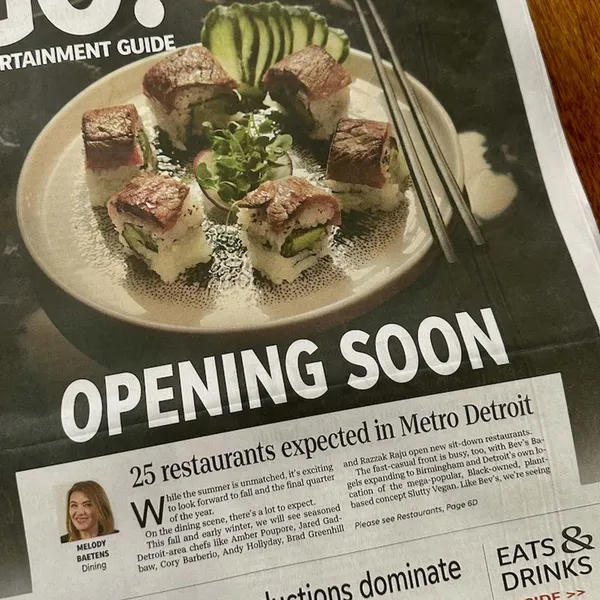
Video New Spots Opening Soon & What Michelin Means for Detroit (w/ Melody Baetens)
The Michelin Guide is bringing its Great Lakes ceremony to Detroit next April, and people have a lot of questions.